Back to measurement guide

Online measurement form

Fill in your measurements below. Your progress is saved automatically — you can close the page and come back anytime. When you're done, download the PDF and send it to us.

You'll need a helper

Many of these measurements — shoulders, back length, inseam — are impossible to take accurately on your own. Grab a friend, or book a free video call with us and we'll guide you through it live.

Personal information

So we know who the measurements belong to and how to reach you.

Gender *
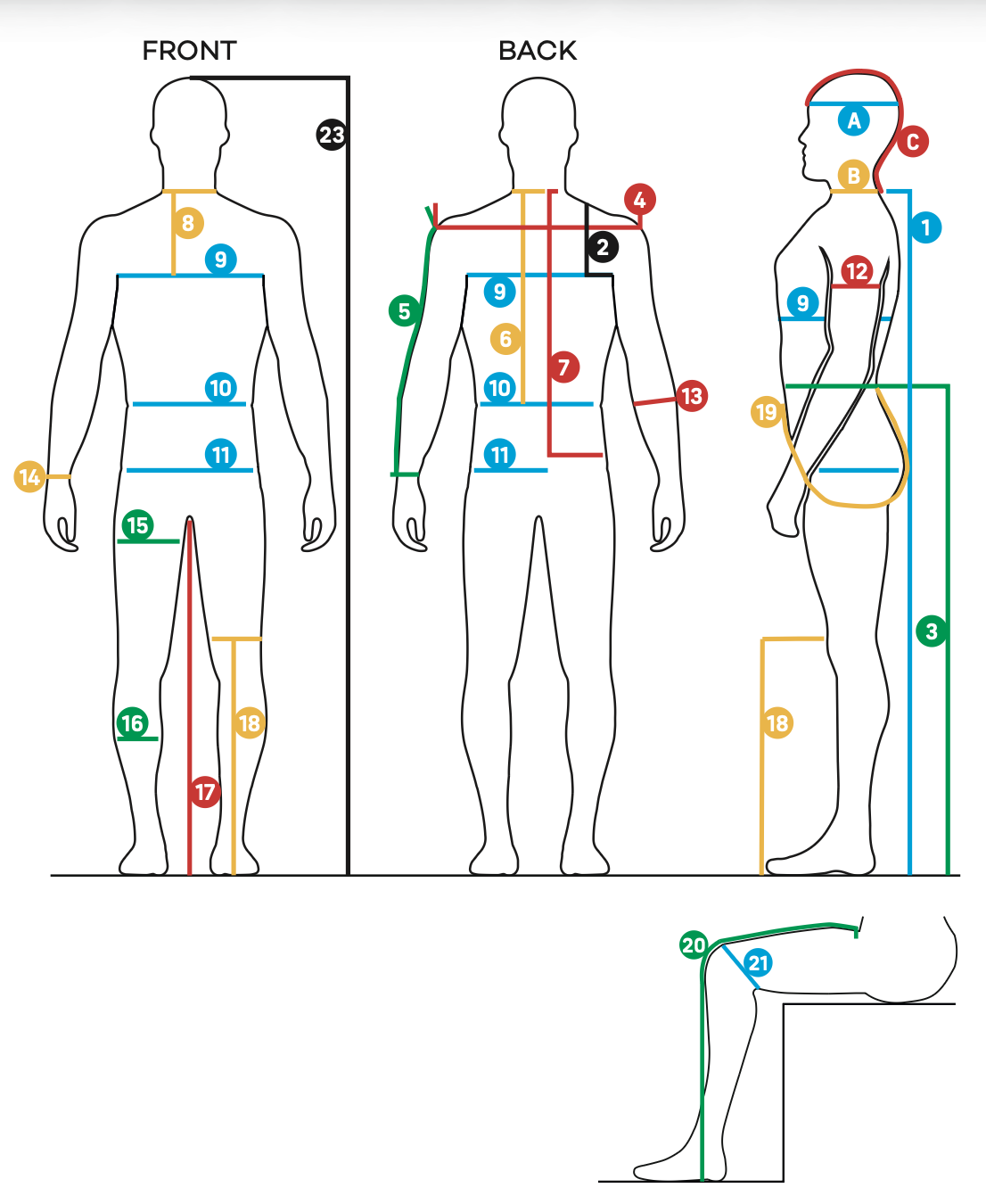
Standing Length Measurements

These are all taken while standing with arms relaxed at your sides, feet about 30 cm apart, looking straight ahead. Your helper should stand behind you and check the tape is straight and level.

23

Head to floor, standing barefoot against a wall.

Why this matters & how to measure

Stand barefoot on a hard floor, back against a wall, looking straight ahead. Have your helper mark the wall at the top of your head and measure from the floor to that mark. Don't look up or down. This is a sanity check — we cross-reference it against your other measurements to make sure everything adds up.

cm
1

From the bony bump at the base of your neck, straight down your back to the floor.

Why this matters & how to measure

Find the bony bump where your neck meets your shoulders (vertebra prominens). Have your helper place the tape end there and run it straight down your back to the floor. Stand tall, don't slouch. This sets the overall suit length — if it's wrong, the suit will bunch at the ankles or pull at the crotch.

cm
2

From the middle of your shoulder, straight down vertically to armpit level.

Why this matters & how to measure

Start from the middle of your shoulder — halfway between your neck and the edge of your shoulder bone. Measure straight down to armpit level. Don't follow the curve of the shoulder — go vertically. This determines where the underarm gusset sits, which affects arm mobility underwater.

cm
6

From the neck base, down the spine to your natural waist.

Why this matters & how to measure

From the same neck base point as #1, measure down the spine to your natural waist. Keep your back straight. This measurement, combined with #7, helps us position the suit's waist and ensure the torso proportions are right.

cm
7

From neck base, down the spine to the top of your hip bone.

Why this matters & how to measure

From neck base, measure down the spine to the top of your hip bone (iliac crest — the bony point you can feel on the side). This determines where the suit's hip panel falls and affects how the suit drapes when you bend.

cm
3

From your natural waist, straight down to the floor.

Why this matters & how to measure

Find your natural waist — the narrowest part of your torso, usually just above the belly button. Measure straight down to the floor. This helps us proportion the upper and lower body of the suit correctly.

cm
4

From one shoulder tip to the other, across the back.

Why this matters & how to measure

Have your helper stand behind you. Measure from the bony tip of one shoulder (acromion) to the other, across the back. The tape should follow the natural curve of your upper back, not pulled tight in a straight line. Too narrow and you won't be able to reach forward; too wide and the suit will have excess material bunching at the shoulders.

cm
5

From shoulder tip, down the outside of the arm to the wrist bone. Measure both, use the longer.

Why this matters & how to measure

Arms straight down at your sides, relaxed. Measure from the bony tip of the shoulder (same point as #4) down the outside of the arm to the wrist bone. Don't bend the elbow. Measure both arms and use the longer one. This sets your sleeve length — critical for seal placement at the wrist.

cm
17

From under the crotch straight down to the floor. Feet 30 cm apart.

Why this matters & how to measure

This is your inseam. Place your hand flat, palm up, and push it snugly into your crotch — the tape starts from where your fingers meet the body. Measure straight down to the floor. Stand with feet about 30 cm apart. This is one of the most important measurements — it determines leg length and where the crotch seam sits. Too short and the suit restricts leg movement; too long and material bunches behind the knees.

cm
18

From just above the kneecap, straight down to the floor.

Why this matters & how to measure

Feel for the top of your kneecap. Start the tape just above it and measure straight down to the floor. This helps us position the knee articulation panel — pre-bent knees are built into quality drysuits for easier finning.

cm
19

From belly button, down between the legs, up to the equivalent point on the lower back.

Why this matters & how to measure

Start from your belly button, run the tape down between your legs, and up to the equivalent point on your lower back. For some people the belly button doesn't align with the natural curve-in point of the back — if so, use the middle of the small of your back as the end point. Keep the tape snug but comfortable. This sets the crotch depth of the suit.

cm
Standing Circumference Measurements

A circumference means wrapping the tape all the way around the body part in a complete loop. Keep the tape level and parallel to the floor — it's easy for the tape to ride up at the back without noticing. Your helper should check from behind. The tape should be snug but not compressing.

9

Around the widest part of your chest. Breathe normally, don't puff up.

+ Slip one finger under the tape
Why this matters & how to measure

Wrap the tape around the widest part of your chest, usually across the nipple line for men or the fullest part of the bust for women. Breathe normally — don't puff up or suck in. Slip one finger between the tape and your body. The chest is the widest part of the suit's torso and gets the most stress during arm movement, so this needs to be right.

cm
10

Around your natural waist — or the widest part of your belly if larger.

+ Slip one finger under the tape
Why this matters & how to measure

Wrap the tape around your natural waist (narrowest part of torso), or around the widest part of your belly if that's larger. Be honest — the suit needs to fit the real you, not the gym-ready you. Slip one finger under the tape. We'll add room for your undersuit on top of this.

cm
11

Around the widest point of your hips and buttocks.

+ Slip one finger under the tape
Why this matters & how to measure

Wrap the tape around the widest point of your hips/buttocks, usually about 20 cm below the waist. This is often the widest point of the lower body. Slip one finger under the tape. The suit's hip area needs to be roomy enough for comfortable leg-lift when finning.

cm
12

Around the thickest part of your upper arm. Arm relaxed, don't flex. Measure both, use larger.

+ Slip one finger under the tape
Why this matters & how to measure

Wrap the tape around the thickest part of your upper arm, about halfway between elbow and shoulder. Arm relaxed and straight down — don't flex. Slip one finger under. Measure both arms, use the larger. This determines how much room is in the upper sleeve.

cm
13

Around the thickest part of your forearm. Measure both, use larger.

+ Slip one finger under the tape
Why this matters & how to measure

Wrap the tape around the thickest part of your forearm, usually about a third of the way down from the elbow. Arm straight, relaxed. Slip one finger under. Measure both, use the larger.

cm
14

Snug around the wrist bone (where a watch sits). No finger gap — this is a seal point. Measure both wrists separately.

Snug fit — no finger gap (seal point)
Why this matters & how to measure

Wrap the tape snugly around the wrist bone — right where a watch sits. Do NOT add a finger for this one — the wrist seal needs to be tight against your skin to keep water out. This is a critical seal point, so measure to the millimetre. Measure BOTH wrists — they're often slightly different, and we'll cut each seal to match.

cm
cm
15

Around the thickest part of your thigh, near the groin crease.

+ Slip one finger under the tape
Why this matters & how to measure

Wrap the tape around the thickest part of your thigh, usually right below the groin crease. Slip one finger under. This measurement determines the leg width at the top — too tight and you'll struggle to fin; too loose and air pockets form when diving.

cm
16

Around the thickest part of your calf. Measure both, use larger.

+ Slip one finger under the tape
Why this matters & how to measure

Wrap the tape around the thickest part of your calf. Slip one finger under. Measure both, use the larger. This affects how the suit fits inside your boots and whether you can pull the legs on easily.

cm
Seated Measurements

For these two measurements, sit on a flat, hard chair (not a sofa) with your thighs horizontal and knees bent at exactly 90 degrees. Feet flat on the floor.

Sit on a flat, hard chair with your knees at 90 degrees and feet flat on the floor.
20

Seated. From the hip crease (skip two fingers) along the top of the thigh to the kneecap centre.

Why this matters & how to measure

While seated, place two fingers flat on top of your leg at the crease where your thigh meets your torso (the hip joint crease). Start the tape immediately after those two fingers (toward the knee) and measure along the top of the thigh to the centre of the kneecap. This tells us how much length to allow for when you're in a seated/finning position — drysuits need extra material here compared to standing.

cm
21

Seated at 90 degrees. Around the knee through the centre of the kneecap.

+ Slip one finger under the tape
Why this matters & how to measure

While seated at 90 degrees, wrap the tape around the knee, going through the centre of the kneecap. The knee is flexed, so this circumference will be larger than a standing knee measurement. Slip one finger under. This is critical for the knee articulation — the suit must have enough room for comfortable finning.

cm
Hood Measurements

Only needed if you're ordering a hood with your suit. All hood measurements are taken snug against the skin — no finger gap.

A

Around the widest part of your head, across the forehead above the eyebrows. Snug, no finger gap.

Snug fit — no finger gap (seal point)
Why this matters & how to measure

Wrap the tape around the widest part of your head — across the forehead just above the eyebrows and around the widest point at the back of the skull. Snug, no finger gap. This is a seal point.

cm
B

Around the base of your neck where a shirt collar sits. Snug against bare skin, no finger gap.

Snug fit — no finger gap (seal point)
Why this matters & how to measure

Wrap the tape around the base of your neck, right where a shirt collar sits. Snug against bare skin, no finger gap. This is a critical seal point — the neck seal keeps all the water out, so millimetre precision matters here.

cm
C

From the centre of your forehead (eyebrow line) over the top of the head to the back of the neck.

Why this matters & how to measure

Measure from the centre of your forehead (at the eyebrow line) up over the top of the head and down to the base of the skull at the back of the neck (the neck base point). This sets the front-to-back fit of the hood.

cm
Suit configuration

Tell us about the suit you'd like built. Not sure yet? Leave blank and we'll discuss options with you.

Customizations

Make the suit yours. All fields are optional — add what you'd like.

Accessories

Add any accessories you'd like with your suit (drysuit bag, wetnotes, etc.). Browse our catalogue for ideas.

Ready to send your measurements?

Download the PDF above, then send it to us via email or WhatsApp.

Body measurement guide